Nuclear Engineering Software,
CivilFEM for ANSYS

Code-based civil and structural engineering workflows integrated with ANSYS for nuclear and safety-critical applications.
CivilFEM for ANSYS extends ANSYS MAPDL and Workbench with civil-engineering check, design and post-processing functions for reinforced concrete, steel, prestressed concrete, geotechnics and nuclear structures. The NPP module adds nuclear-code checking, seismic utilities, seismic margin assessment, post-tensioned concrete tools and a documented nuclear QA/V&V framework. It is intended for engineers working with solid and shell FE models who need to convert analysis results into code-based structural verification and reinforcement design. The supplied material shows workflows for reactor and containment structures, turbine foundations and seismic re-evaluation of existing plants.
Nuclear capabilities
ACI 349-13; ACI 359-04; ANSI/AISC N690-94; ANSI/AISC N690-06 (LRFD and ASD); ASME B&PV Code Section III, SubSection NF; AISC ASD 9th Edition; ASCE 4-98; EPRI NP-6041-SL; ITER Structural Design Code; EUROCODE 2; EUROCODE 3; and Eurocode 8 for spectrum definition.
Nuclear code checking
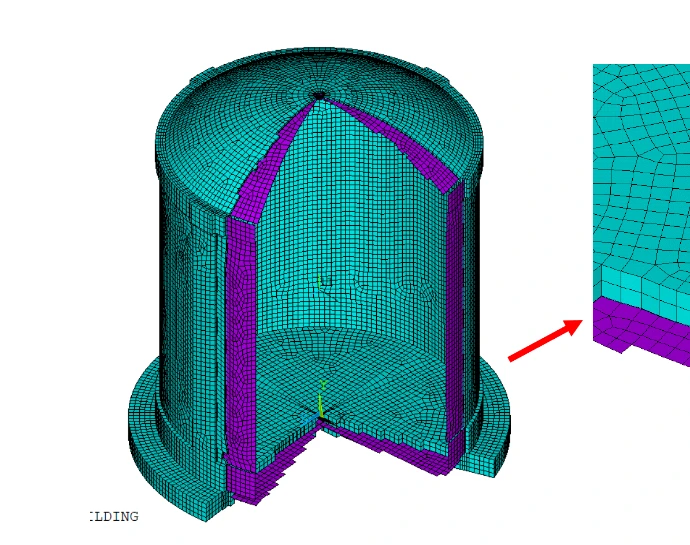
CivilFEM adds code-based checking and design to ANSYS results for reinforced concrete and steel structures. The supplied NPP material documents ACI 349, ACI 359, AISC N690, ASME Section III Subsection NF and ASCE 4 implementations, subject to confirmation of the editions supported by the current release.
Prestressed nuclear concrete
Three-dimensional tendon geometry, short- and long-term prestress losses, equivalent prestressing actions and code checking are supported. The source material also demonstrates modification and re-analysis of a prestressed reinforced-concrete containment under internal pressure.
Concrete and thermal behaviour
The CivilFEM material library includes nonlinear and time-dependent concrete behaviour, creep and shrinkage. Cracked-section stiffness, reinforcement stress redistribution and thermal effects on reinforced concrete are also documented.
Seismic analysis and margin
Response-spectrum and transient analysis workflows are documented together with seismic sign combinations and HCLPF-based seismic margin assessment. The methodology addresses capacity-demand assessment and can account for nonlinear section capacity and interaction between demand components.
Solid-to-shell design
CivilFEM can derive an equivalent shell representation from three-dimensional solid models. Forces and moments obtained by integrating solid stresses can then be used for shell-based code checking and reinforcement design
Time history and FRS
A documented nuclear case study includes response-spectrum analysis, time-history analysis and floor response spectra generation.
Combinations and post-processing
Code and user-defined combinations, static and seismic cases, result envelopes, reinforcement contours and tabulated listings support the transition from ANSYS analysis results to structural verification.
How CNCI supports you
01.
Licensing
CNCI provides CivilFEM licence quotations and helps clients define the appropriate CivilFEM configuration for their ANSYS-based civil and structural engineering workflow.
02.
Implementation
We support implementation of CivilFEM within existing MAPDL and Workbench workflows, including model organisation, materials, sections, load combinations and code-checking set-up.
03.
Training
Training can be focused on the workflows relevant to the engineering team, including reinforced-concrete design, nuclear code checks, prestressing, seismic analysis and post-processing..
04.
Technical support
CNCI provides a technical point of contact for CivilFEM users in the Nordics and coordinates software-specific issues with Ingeciber where developer input is required.
05.
Engineering model review
CNCI can review CivilFEM modelling and verification workflows, including assumptions, combinations, code settings and interpretation of structural results, as a separate engineering service.
Software activities are kept separate from CNCI's Owner's Engineer and independent review assignments.
Frequently asked questions about CivilFEM for ANSYS
The supplied CivilFEM documentation identifies ACI 349-13, ACI 359-04, ANSI/AISC N690-94 and N690-06, ASME B&PV Section III Subsection NF, ASCE 4-98, EPRI NP-6041-SL and the ITER Structural Design Code. General CivilFEM workflows also include Eurocode 2 and Eurocode 3, with Eurocode 8 referenced for seismic spectrum generation.
The supplied CivilFEM material identifies a Verification Examples Handbook and the CVF Verify programme, and describes a QA framework referring to ISO 9001:2008, NRC 10 CFR Part 50 Appendix B, NRC 10 CFR Part 21 and ASME NQA-1. A 2014 presentation states that approximately 1,800 V&V examples existed at that time.
The historical material illustrates floating network licensing, while current licence models and commercial terms are not defined in the supplied documents. CNCI can provide a licence quotation and coordinate the appropriate configuration for the required ANSYS/CivilFEM workflow.
Discuss CivilFEM for your engineering workflow
Talk to CNCI about licensing, implementation, training or a technical demonstration of CivilFEM for ANSYS.